The Science Behind Why Personalised Stories Matter for Children's Development
When a child hears their own name in a story, something lights up in their brain. That's not a metaphor — it's literal neural activation, measurable in the lab, distinct from how the brain responds to any other word in the language.
Personalised children's books are often dismissed as a novelty. A cute gimmick. A nice gift. But the research tells a different story — one that touches memory, attention, empathy, identity, and the way young children come to understand who they are. Here's what the evidence actually says about why personalisation matters more than most parents realise.
The Cocktail Party Effect: Why Your Child's Name Is Special
In 1953, the cognitive scientist Colin Cherry ran a now-famous series of experiments on selective attention. He wanted to know how the brain manages to filter one conversation from the noise of a crowded room. What he found became known as the Cocktail Party Effect: even when you're deep in conversation on one side of a busy room, the sound of your own name spoken across the room will cut through the noise and pull your attention instantly.
Your brain is wired — from a very early age — to flag its own name as high-priority information. It is, neurologically speaking, one of the stickiest sounds a human being can hear.
Now apply that to a bedtime story. When a child reads a generic book about "a little girl," their attention drifts the way any attention drifts. When they read a book where the little girl is called Ama, or Kemi, or Zion — their name — the brain leans in. Engagement rises. Focus sharpens. Every page is underlined by a quiet neural spotlight the child isn't even aware of.
That's not marketing. That's seventy years of attention research.
Narrative Transportation: Getting Lost Inside the Story
Psychologists use the phrase narrative transportation to describe the feeling of being "inside" a story — losing track of the room around you, feeling what the characters feel, believing for a moment that their world is your world. The more transported a reader is, the more they absorb a story's messages, remember its details, and empathise with its characters.
Transportation is harder for children than for adults. Young minds are still learning to hold characters in their heads, to track plot, to suspend disbelief. Anything that shortens the gap between the reader and the protagonist helps.
Personalisation does exactly that. A child doesn't have to imagine themselves into the shoes of a stranger — the shoes already fit. The hero has their name, their hair, their family. Transportation happens faster and runs deeper, which means the story's emotional lessons land with more weight.
The Self-Reference Effect: Why We Remember Ourselves Best
In 1977, Rogers, Kuiper and Kirker published one of the most replicated findings in memory research. They called it the self-reference effect: information that we relate to ourselves is remembered significantly better than information we process in any other way.
Ask someone to memorise a list of adjectives. If they think about the meaning of each word, they'll remember some. If they think about whether each word applies to them, they'll remember far more. The self is, quite literally, the best filing cabinet the brain has.
This has enormous implications for children's books. A story about a generic child learning to be brave is a story. A story about your child — with their name, their face, their grandmother, their heritage — learning to be brave is a memory. It gets encoded differently. It lingers.
When parents tell us their child asks for the same Omo Tales book every night for a month, this is part of what's happening underneath. The brain has flagged this story as being about me, and the "about me" file is the one children return to most.
Identity Formation Between Ages Three and Seven
Developmental psychologists broadly agree that the years between three and seven are when children build the scaffolding of their self-concept. They start to answer the question "who am I?" — and the answers come from the world around them. From what parents say. From what teachers notice. From who they see on screen, in the playground, and in books.
Dr Rudine Sims Bishop's famous framing of books as mirrors, windows and sliding glass doors — mirrors that reflect a child back to themselves, windows into other lives, doors into worlds they might step through — has shaped how educators think about representation for more than thirty years.
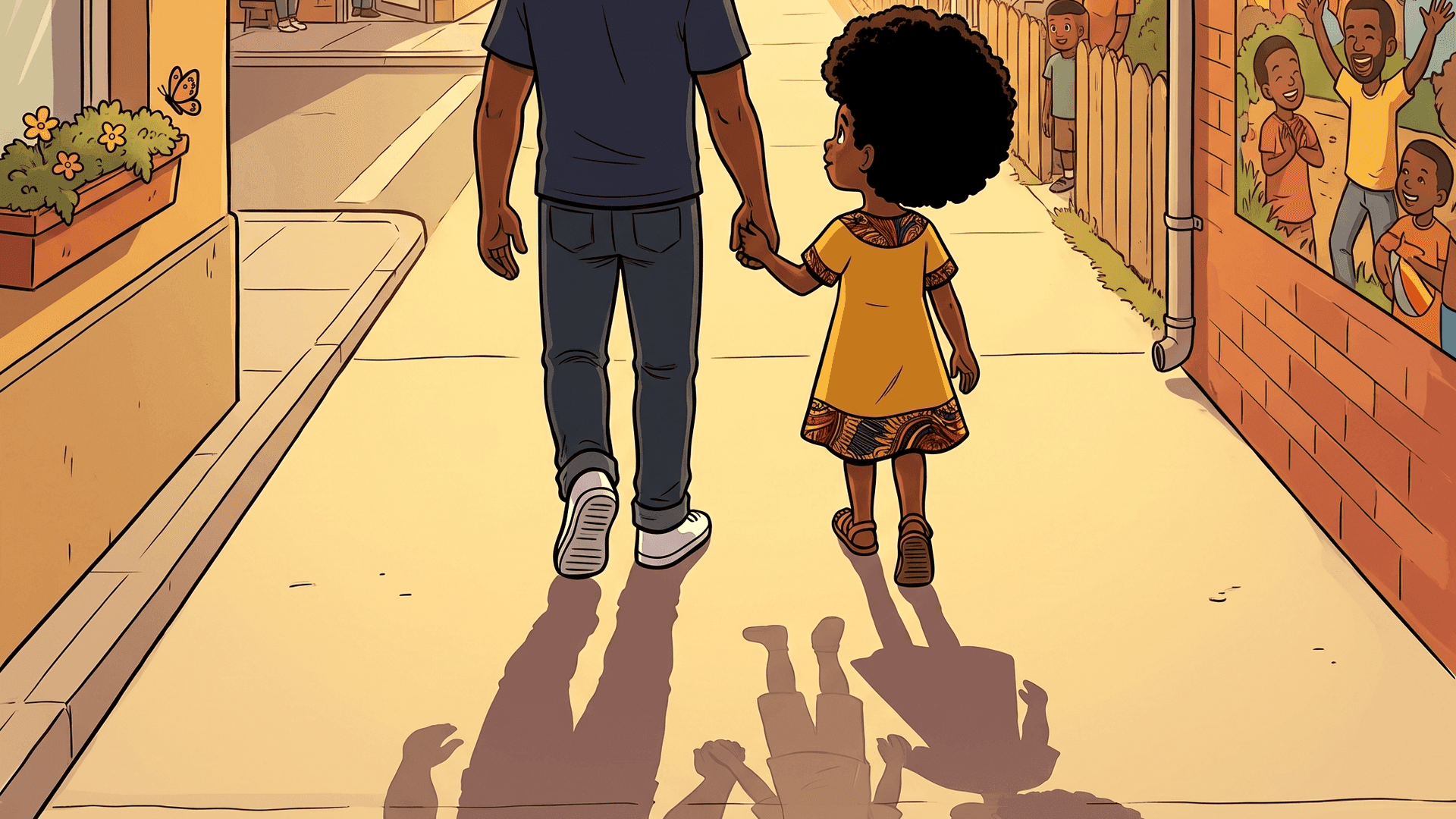
Personalised books are the most literal mirror a child can hold. Not a character who looks a bit like them. A character who is them, doing something brave or kind or magical. At an age when the self is still being written, that matters. Being the hero of the story plants a seed: I am the kind of person who can do this. Repeated often enough, that seed grows into something a child carries into school, friendships and the harder years ahead.
Create a story where your child is the hero →
Stories as Emotional Rehearsal
Young children don't have the vocabulary to talk through big feelings the way adults do. They externalise them instead — into toys, into play, into characters. A child who is anxious about the first day of school might not say "I'm anxious." But they'll ask for a story about a rabbit who is scared on the first day of school, and they'll ask for it every night.
Stories are emotional rehearsals. They let children try on fear, loss, jealousy, courage and pride in a safe place before life asks them to feel those things for real. And when the character at the centre of the rehearsal is the child, the rehearsal runs deeper. The emotional muscles being built are their own.
This is why stories about small, specific moments — a first haircut, a missing grandparent, a scary change, a proud achievement — matter so much. They give children a way to process what's happening to them through the safer distance of narrative.
The Bond at Bedtime
One last thing the research is unambiguous about. The ritual of reading with a child at bedtime is, on its own, a developmental gift. Language development, attachment, vocabulary, literacy readiness, emotional co-regulation — all of it is strengthened by shared reading.
Personalised books extend that ritual, because children ask to re-read them more often than generic books. Parents tell us the same thing again and again: "She makes us read it every night." That extra time, sitting together, voices low, is where a lot of the real magic of childhood actually lives.
Why We Obsess Over the Details
At Omo Tales, every design decision — the hair that matches your child's texture, the skin tone rendered with care, the heritage details woven into the story, the name printed on every page — is rooted in this body of research. Not because it makes for good marketing copy, but because the evidence is clear that these details change how deeply a book is experienced by a small person who is still working out who they are.
A children's book can be a toy. It can also be something closer to a tool — the kind of tool that quietly helps a child build their sense of self, one bedtime at a time. We're building for the second kind.
Share this article
Create your child's story
A personalised storybook with a character that truly looks like your child. Heritage woven into every page.
Start CreatingTry our free colouring page
Get a free personalised colouring page featuring your child — delivered straight to your inbox.
Get Free Colouring Page