
How Personalised Books Help Children Build Confidence
The Moment It Clicks
There's a specific expression a child makes the first time they realise a story is about them. Their eyes go wide, then narrow. They look at the page, then up at you, then back at the page. Sometimes they touch the illustration, as if checking it's real. Sometimes they go very quiet. Sometimes they burst out laughing and shout, "That's me!"
Parents who've seen it never forget it. It looks small from the outside — a toddler pointing at a book — but something much bigger is happening underneath. A child is discovering that they are worth writing about.
That moment is the whole reason personalised books exist. And it turns out, it matters far more to a child's development than most of us realise.
The Science of Self-Recognition
Between the ages of roughly eighteen months and eight years, children are doing the enormous work of figuring out who they are. Psychologists call this period "identity formation," and it's one of the busiest cognitive phases of a human life. Children are sorting through every face, voice, story, and mirror they encounter, asking a quiet question: Where do I fit in this world?
Books are one of the most powerful answers they receive.
In 1990, the late Dr. Rudine Sims Bishop, a scholar of children's literature, introduced a framework that has shaped how educators and publishers think about books ever since. She described books as mirrors, windows, and sliding glass doors. A window lets a child look into someone else's life. A sliding glass door lets them step through it imaginatively. But a mirror reflects the child back to themselves — and Bishop argued that every child needs to see themselves reflected in the stories they read.
"When children cannot find themselves reflected in the books they read," Bishop wrote, "they learn a powerful lesson about how they are devalued in the society of which they are a part."
A personalised book, then, isn't just a nice gift. It's the most literal mirror a book can possibly be. The child on the page has their name. Their hair. Their skin. Their family. There is no ambiguity about whether the story is "for them."
What Confidence Actually Means in Children
Confidence in young children is often misunderstood. It isn't loudness or bravado. A genuinely confident four-year-old isn't the one doing backflips off the sofa — they're the one who can walk into a new room, settle in, and feel sure of themselves while they work out what's happening.
Confidence, at its root, is a quiet certainty. It's the internal sense that:
- I belong here.
- I matter.
- I am someone worth paying attention to.
You can't pep-talk a child into those beliefs. You can tell a five-year-old she's special a hundred times a day, and it won't land the way a single story lands where she is the hero who saves the day. Children absorb identity through experience, not affirmation. And stories are some of the most vivid experiences they have.
Three Ways Personalised Books Build Confidence
1. Their name makes them the hero, not the sidekick
Most children's books follow a main character and, if you're lucky, a best friend. Guess which one children usually cast themselves as when they listen? Too often, the sidekick. The helper. The smaller role.
When a child hears their own name read aloud as the protagonist — the one making decisions, solving problems, showing courage — the story repositions them. They're not watching from the wings. They're centre stage. Over time, that repetition shapes how they see themselves in the world: not as someone things happen to, but as someone who acts.
2. Seeing themselves in the illustrations normalises who they are
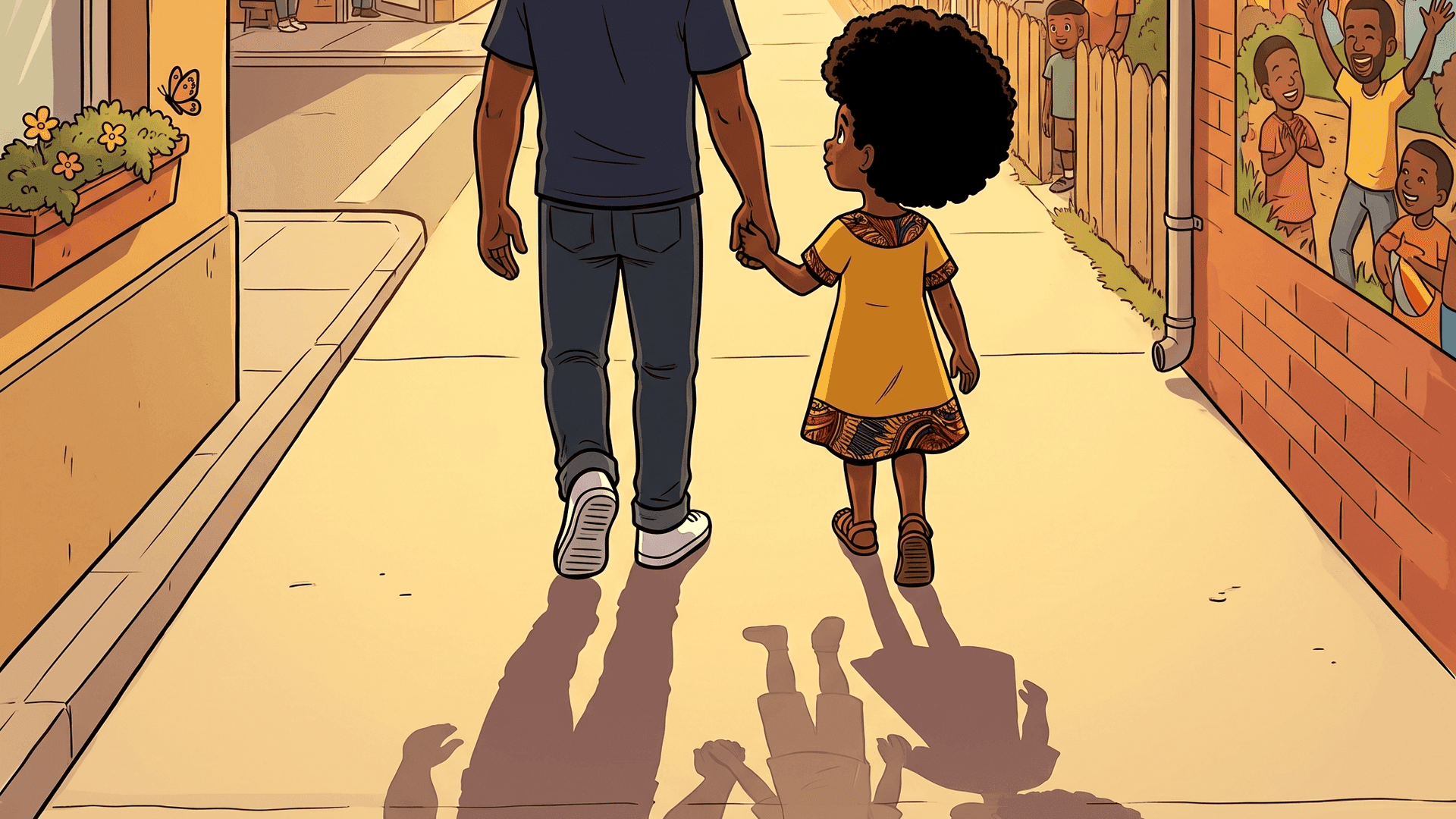
This is where personalised books do something that even the best traditional books often can't. A child with 4C hair, medium-brown skin, and a wide smile can read hundreds of picture books before they find a character who looks like them — and when they do, it's often a "diversity title" rather than just a joyful, everyday story.
When a child sees their own features drawn lovingly on the page — not as an exception, not as a lesson about tolerance, just as the normal hero of a normal story — something settles in them. Their appearance stops being something to explain or defend. It becomes the default. And defaults shape self-image more powerfully than almost anything else.
This matters especially for children from underrepresented backgrounds. A Black child whose afro, locs, or braids appear on the page of a beautiful hardback book is receiving a message that mainstream media rarely sends: your hair is storybook-worthy.
3. Repetition turns stories into self-concept
Bedtime stories are read again and again. A favourite book might be read two hundred times before a child outgrows it. That repetition isn't just soothing — it's formative. Whatever is in that story gets woven into the child's inner narrative about themselves.
If the hero of the book being read on loop shares their name, their face, and their bravery, that becomes part of who they believe they are. Confidence isn't built in a single reading. It's built in the quiet accumulation of a thousand small moments where a child hears, in effect: this is you, and you are wonderful.
Speaking of moments — if you'd like a small, free way to see your child light up, we make free personalised colouring pages too. Grab one here and watch their face when they see themselves on the page.
What Research Tells Us
We try to be careful about citing statistics we can't personally verify, so here's what we can say honestly: research in developmental psychology and media studies consistently shows that children who see themselves reflected positively in the stories, images, and media around them tend to develop stronger self-esteem and a more secure sense of identity. Scholars like Dr. L. Monique Ward have spent decades showing how media representation shapes children's self-concept, particularly for children from marginalised groups.
The direction of the evidence is clear, even when the exact numbers vary: representation matters, mirrors matter, and stories that centre a child's identity contribute meaningfully to how they grow.
Beyond the Book: How Parents Can Amplify It
A personalised book is a starting point, not a finish line. The confidence boost gets much bigger when parents lean into the story alongside the child. A few simple things to try:
- Ask questions that invite them into the story. "If you were brave like the character in the book, what would you do tomorrow at school?" It turns the book into a rehearsal space for real life.
- Draw connections to the everyday. When something in the story mirrors something in real life — a family meal, a moment of nervousness, a small act of kindness — point it out gently. "Remember how you did this last week? That was just like the book."
- Let them "read" the book back to you. Even pre-readers can retell a story they know well. Letting them be the storyteller shifts them from passive listener to active author of their own narrative. It's one of the quickest confidence builders there is.
Small rituals, repeated often, do far more than grand gestures.
Why We Do This
We started Omo Tales because we wanted Black children, in particular, to open a book and see themselves as the hero — rendered with care, drawn with beauty, named by name. But the truth is, every child deserves that experience. Every child deserves at least one book where the story is unmistakeably, lovingly, about them.
That first moment of recognition — the wide eyes, the quiet pause, the finger tracing the illustration — is the beginning of something that lasts a lifetime. We've seen it enough times to know it's real.
If you'd like to give your child that moment, we'd love to help.
Share this article
Create your child's story
A personalised storybook with a character that truly looks like your child. Heritage woven into every page.
Start CreatingTry our free colouring page
Get a free personalised colouring page featuring your child — delivered straight to your inbox.
Get Free Colouring Page